
Con su tamalada tradicional, el club de lectura de ingeniería concluyó sus actividades del 2025.
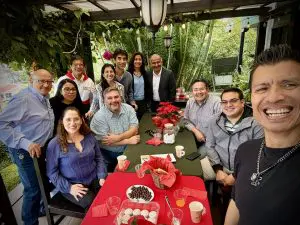
El club de lectura de Ingeniaría Emprearial concluyó actividades del 2025. Foto de Carlos Méndez.
«Nos reunimos aproximadamente cada quince días para discutir un libro y terminamos el año con un artículo de Joel Mokyr, premio nobel de Economía 2025 —galardón que compartió con Philippe Aghion y Peter Howitt—, titulado «The Contribution of Economic History to the Study of Innovation and Technical Change: 1750-1914». Este artículo describe el rol que han tenido el trabajo artesanal, la ciencia y la ingeniería en el progreso acelerado observado durante la Revolución Industrial», explicó Carlos Méndez, director de la carrera Ingeniería Empresarial.
Los miembros de este club leyeron y discutieron obras como:
The Wisdom of Crowds, de James Surowiecki; Governing the Commons, de Elinor Ostrom; Fooled by Randomness: The Hidden Role of Chance in Life and in the Markets, de Nassim Nicholas Taleb; Moral Tribes: Emotion, Reason, and the Gap Between Us and Them, de Joshua Greene; Noise: A Flaw in Human Judgment, de Daniel Kahneman, Olivier Sibony y Cass R. Sunstein; Why Nations Fail: The Origins of Power, Prosperity, and Poverty, de Daron Acemoglu y James A. Robinson; The Evolution of God, de Robert Wright; The Tyranny of Merit: What’s Become of the Common Good?, de Michael Sandel; 2084 and the AI Revolution, de John C. Lennox; Blueprint: The Evolutionary Origins of a Good Society, de Nicholas Christakis; Descartes’ Error: Emotion, Reason, and the Human Brain, de Antonio R. Damasio; Open: The Story of Human Progress, de Johan Norberg; Bourgeois Dignity: Why Economics Can’t Explain the Modern World, de Deirdre McCloskey; Factfulness: Ten Reasons We’re Wrong About the World—and Why Things Are Better Than You Think, de Hans Rosling, Ola Rosling y Anna Rosling Rönnlund.
Entre lecturas exigentes, conversaciones animadas y una mesa compartida, el club de lectura de ingeniería cerró el año reafirmando que la curiosidad intelectual y el diálogo constante son parte esencial de la vida universitaria.
Contacto:
Facultad de Ciencias Económicas
economia@ufm.edu
Guatemala, 6 de enero del 2026
Recientes

- 1
- 2
- 3
- …
- 1.373
- Siguiente »